You're using an "Internet Explorer" web browser that's no longer supported.
This website will not function correctly when using when using Internet Explorer,
so please upgrade to a modern web browser, like Edge, Chrome, or Firefox.
For decades, enterprise modernization has often followed a familiar pattern: move an application from an older technology stack to a newer one.
The reasoning was understandable. Experienced developers were becoming harder to find. New capabilities were emerging elsewhere. Remaining on the existing platform appeared to create greater long-term risk. Eventually, migration began to feel less like one modernization option and more like its inevitable definition.
Artificial intelligence is beginning to challenge that assumption.
This does not mean migration is going away. It means organizations may have more credible ways to modernize than they did before.
From Language Proficiency to System Understanding
AI is changing the workforce side of modernization first.
Deep engineering expertise and domain knowledge still matter. In fact, they may become more important. But prior familiarity with every API, library, framework convention, and language idiom may become less of a barrier to productivity.
That changes one of the questions organizations have historically asked about established systems: Where will we find people who know this technology ten years from now?
The more relevant question may become: Can our people understand, maintain, and evolve this system effectively?
A developer's familiarity with a language matters. But the greater challenge in a mission-critical application is often understanding what the system does, why it behaves as it does, and which business and operational assumptions have accumulated within it over decades.
AI can help developers navigate unfamiliar technical details. It cannot replace the judgment required to understand the consequences of changing a system the business depends on.
Bringing New Capabilities into Existing Environments
AI is also changing where modernization can happen.
Historically, gaining a major new capability often required moving an application to a different technology stack. Increasingly, modern tooling, integration patterns, security improvements, and AI-assisted development can be introduced within an existing environment.
We are seeing this in our own work with the VAST Platform. The VAST AI Assistant and our ADK (Agent Development Kit) are helping developers investigate, extend, and integrate applications from within the environment they already use.
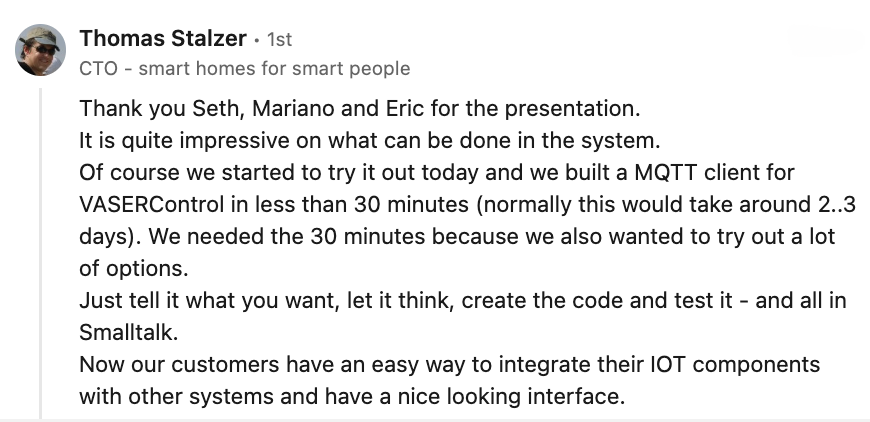
A recent customer experience illustrated the potential. After seeing the VAST AI Assistant, longtime VAST developer Thomas Stalzer used it to create an MQTT client in approximately 30 minutes. He estimated that the same work would ordinarily have required two or three days.
We did not build that client for him. We gave him tooling that helped him accomplish more within his existing environment.
Traditional modernization cycles often moved an application from one technology stack to the next. AI may allow more of those cycles to happen within the technology stack itself.
Modernization by Replacement or Modernization by Evolution
The strategic question is no longer simply whether one language or framework is newer than another.
It is whether an environment can enable an organization to meet its current needs, incorporate new capabilities, and continue evolving at an acceptable rate.
This also changes how we should think about risk.
Moving to a larger vendor or a more mainstream technology stack is sometimes treated as inherently safer. But vendor size and platform commitment are not the same thing. Large technology companies change priorities. Products are reorganized, frameworks lose support, and strategic platforms can become secondary offerings.
Instantiations has supported and advanced the same core platform for decades. That continuity is unusual, and it has taught us that sustained platform commitment can itself be a form of risk reduction.
AI now creates an opportunity to pair that continuity with a faster rate of experimentation and delivery. Stability and innovation do not have to be opposites.
AI Can Also Make Migration Easier
There is an important counterargument.
If AI makes it easier to develop within an existing platform, does it also make it easier to migrate away from that platform?
Yes. AI can lower the mechanical effort involved in either approach.
But the risks are not necessarily symmetrical.
AI can help translate code into another language or framework. It cannot automatically guarantee the preservation of decades of business behavior, edge cases, operational knowledge, data semantics, integrations, and assumptions embedded in a mission-critical system.
Rewriting Software is Not the Same as Preserving the System
If AI is applied to understanding, testing, documenting, extending, refactoring, upgrading, and integrating an existing application, an organization may be able to achieve many of its modernization goals without accepting the full risk of recreating that application somewhere else.
That will not always be the correct path. Vendors disappear. Platforms stop evolving. Regulatory requirements, acquisitions, architectural constraints, strategic consolidation, or economics can make migration the right decision.
The point is not that migration is bad. The point is that if a platform remains supported, continues to evolve, and can absorb modern capabilities, migration should no longer be treated as the automatic definition of modernization.
Organizations now have an opportunity to evaluate modernization more deliberately:
What outcomes are we trying to achieve?
Which constraints are actually preventing those outcomes?
How much valuable knowledge is embedded in the existing system?
Can the current platform support the capabilities we need?
Which path produces the right balance of progress, continuity, cost, and risk?
For years, replacement was often seen as modernization's inevitable destination. AI may be making modernization through evolution dramatically more capable.
Modernization may no longer mean moving an application to the technology of the future.
Increasingly, it may mean bringing the technology of the future to the application.